Does your shoulder hurt when you raise your arm, get dressed, or sleep? Find out what might be causing it and how physical therapy can help.
Shoulder pain when raising your arm: What could be causing it?
Shoulder pain when raising the arm is a very common reason for seeking medical care. It can occur while getting dressed, reaching for an object on a shelf, exercising, working with your arms raised, or even when sleeping on that side. Some people feel a sharp pain at a specific point in the movement; others experience pain throughout the entire range of motion or a gradual loss of strength and mobility.
This discomfort is often attributed directly to a tendon problem or “impingement.” However, the shoulder is a complex region, and the pain cannot be explained solely by a single structure or imaging finding. To understand what is happening, it is necessary to assess how the pain began, which movements affect it, what the shoulder’s current range of motion is, and how it impacts each person’s daily activities.
Why are we talking about tendinopathy?

Tendinopathy is a broad concept that describes pain and loss of function related to a tendon, without reducing the entire process to isolated inflammation. It is the terminology we currently use to refer to this type of problem.
In the shoulder, the rotator cuff tendons help control and stabilize the joint as we move our arm. They can become problematic when the demands of work, sports, or daily life temporarily exceed their ability to withstand them.
This can occur after a sudden increase in training intensity, performing repetitive overhead tasks, or a period of reduced activity followed by an unusual physical exertion.
However, pain when raising the arm does not in itself confirm the presence of tendinopathy. The pain may also be related to other structures in the shoulder, limited range of motion, a traumatic injury, or even symptoms originating in the cervical region. That is why it is important not to treat just a diagnosis.
What is this so-called “impingement” of the shoulder?
For years, much of the shoulder pain was explained by the notion that, when the arm was raised, certain structures became “pinched” under the acromion. This explanation is overly simplistic and can cause a person to be afraid to move their shoulder.
Raising your arm involves the coordinated movement of the humerus, scapula, clavicle, muscles, and tendons. Just because a movement hurts doesn't necessarily mean that the tissues are being damaged every time you do it.
In many cases, the problem has more to do with the sensitivity of the area and an insufficient ability to tolerate a certain amount of stress than with unavoidable mechanical compression.
That is why, instead of banning the movement indefinitely, we usually look for a manageable way to keep it going and gradually regain our strength and confidence.
What symptoms might occur?
Symptoms vary depending on the individual and their possible cause. Some of the most common symptoms are:
- Pain when raising the arm forward or to the side.
- Difficulty putting on a jacket, fastening a bra, or reaching around to one's back.
- Pain when picking up or placing objects high up.
- Discomfort when exercising, throwing, swimming, or performing overhead movements.
- Nighttime pain or difficulty sleeping on the affected shoulder.
- A feeling of weakness or loss of confidence when carrying a heavy load.
- Stiffness or progressive loss of mobility.
These symptoms alone are not sufficient to identify a specific structure. Age, the onset of pain, the presence of trauma, passive and active range of motion, muscle strength, and the presence of cervical or neurological symptoms help guide the evaluation.
Do I need an ultrasound or an MRI?
Not always. Current clinical guidelines do not recommend routinely ordering imaging tests at the outset when rotator cuff tendinopathy is suspected.
In many cases, a detailed medical history and a physical examination provide the information needed to begin conservative treatment.
In addition, an ultrasound or an MRI may reveal changes in the tendons even in people who are not experiencing pain. Finding a structural abnormality does not automatically mean that it is the sole cause of the symptoms, nor does it alone determine the treatment.
Imaging tests may be necessary after an injury, when a serious injury is suspected, or when pain and disability do not improve after an appropriate period of treatment. In such cases, the results should be interpreted in conjunction with the patient’s physical examination and clinical course.
Is it better to rest until the pain goes away?
Temporarily reducing the activities that most irritate the shoulder can be helpful, especially at first. However, prolonged complete rest also reduces the tissue's strength and can make it increasingly difficult to use the arm again.
The key is usually to adjust the load, not to eliminate it entirely. This may involve temporarily reducing the weight, the number of repetitions, the speed, or the range of motion for certain exercises, while continuing with other activities that are tolerable.
A certain degree of discomfort during exercise does not necessarily mean that damage is occurring. The important thing is to monitor the intensity, how long the increased symptoms last, and how the shoulder responds in the hours and days that follow. The progression should be tailored to each individual.
How can physical therapy help?
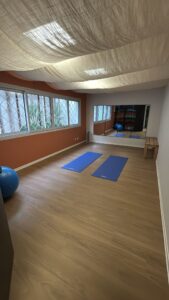
At Clínica174, we begin with a personalized physical therapy assessment. We analyze the onset and progression of pain, the activities that aggravate it, shoulder and neck mobility, strength, tolerance to different loads, and each patient’s goals.
Based on the results, treatment may include:
- Education to help people understand pain and know how to adapt activities.
- Mobility exercises when there is a significant limitation.
- Exercises for motor control and coordination of the shoulder and scapula.
- Progressive strength exercises for the rotator cuff and associated muscles.
- Adjusting the intensity of work, the gym, or sports.
- A specific progression for resuming weightlifting, throwing, swimming, or overhead exercises.
- Manual techniques as a complementary approach to relieve pain in the short term when indicated.
Current evidence identifies active rehabilitation—through control and strength exercises using adapted loads—as one of the initial pillars of treatment for rotator cuff tendinopathy.
There is no single exercise that is perfect for everyone's shoulders: the choice of exercise, the intensity, and the progression must be tailored to each person's specific symptoms and needs.
Do machines or manual therapy solve the problem?
Some manual techniques can help reduce pain in the short term and make it easier to move. However, their effects are primarily supplementary.
To restore shoulder function and reduce the risk of the discomfort returning, it is usually necessary to also work on strength, control, and tolerance for the activities the person wishes to perform.
Similarly, applying a passive technique without active progression is usually not enough. Current clinical guidelines do not recommend, for example, therapeutic ultrasound for treating rotator cuff tendinopathy. The choice of any tool must be based on an assessment and have a clear objective within the treatment plan.
When should you seek immediate medical attention?
It is advisable to seek an early medical or physical therapy evaluation if the pain significantly limits your usual activities, progressively worsens, or does not improve after several weeks.
You should seek medical attention immediately if any of these signs appear:
- Severe pain following a fall, blow, or sudden movement.
- Visible deformity or inability to move the arm following a traumatic injury.
- Sudden and marked loss of strength.
- A very swollen, warm shoulder, or one accompanied by a fever or general malaise.
- Shoulder pain accompanied by chest tightness, shortness of breath, sweating, or nausea.
- Loss of sensation, persistent tingling, or weakness that spreads down the arm.
Treatment for Shoulder Pain in Palma de Mallorca
The same painful movement can have different causes. Therefore, treatment should not be based solely on a diagnosis such as “tendinopathy” or on an imaging result, but rather on each person’s overall situation.
At Clínica174 in Palma de Mallorca, we conduct a personalized assessment and design a physical therapy and therapeutic exercise plan tailored to your pain, your activity level, and your goals.
If your shoulder hurts when you raise your arm, sleep, work, or exercise, you can contact our team to have your condition evaluated and get help regaining range of motion, strength, and confidence.